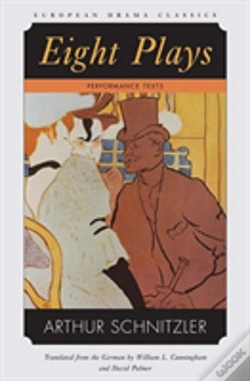
Eight Plays

Performance Texts

by Arthur Schnitzler
language: english
Publisher: NORTHWESTERN UNIVERSITY PRESS, August of 2007 ‧
114,59€
OUT OF STOCK OR NOT AVAILABLE
Sell ​​your book
Represents Schnitzler's dramatic work from 1886 to 1915. This collection includes "Roundelay" and "Anatol" (with additional scenes and an alternate ending), as well as "Professor Bernhardi" and "Hour of Realizing".

Eight Plays

Performance Texts

by Arthur Schnitzler

Property Description
ISBN: 9780810119321
Publisher: NORTHWESTERN UNIVERSITY PRESS
Release Date: August of 2007
Language: English
Dimensions: 130 x 197 x 30 mm
Cover: Hardcover
Pages: 474
Format: Book
Collection: European Drama Classics
Categories: Books in English > Art > Performing Arts
Books in English > Others
EAN: 9780810119321

ABOUT THE AUTHOR

Arthur Schnitzler

Arthur Schnitzler (1862-1931) was an Austrian physician and writer, considered one of the great names in German-language literature during the transition from the 19th to the 20th century.
Born in Vienna into an upper-middle-class Jewish family, Schnitzler trained as a doctor and specialized in psychiatry. His clinical experience profoundly influenced his writing, especially regarding his interest in the subconscious and the psychological complexities of his characters.
In literary circles, Schnitzler became known as one of the leading representatives of the Jung-Wien, Viennese modernist movement. His work explores themes such as desire, morality, and social hypocrisy, often in the form of plays and short stories. Among his most notable books are... Lieutenant Gustl, one of the earliest examples of stream of consciousness in literature, and The Story of a Dream, which inspired the film Eyes Wide Shut, by Stanley Kubrick.
Schnitzler was also the target of controversy during his career, especially due to the provocative nature of his works, which addressed taboo subjects such as sexuality and infidelity. His work was criticized by both the conservative society of the time and by anti-Semites. Despite this, the literary impact of his work endured and was frequently compared to Nietzsche and Freud, with whom he shared an interest in psychoanalysis and human nature.
The writer lived intensely through the cultural and social transformations of Vienna at the beginning of the 20th century, but the rise of Nazism marked his final years. Schnitzler died in 1931, shortly before his works were banned by the Nazi regime. Today, he is considered a central figure in modernist literature, with a body of work that continues to be studied and valued for its psychological depth and its dimension of social criticism.
Many of his books have been adapted for theater and film.

(see more)

BOOKS FROM THE SAME COLLECTION

BY THE AUTHOR