


adicionar à lista de desejos
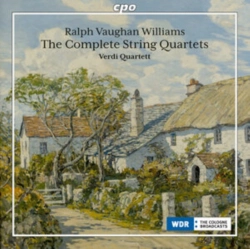
Ralph Vaughan Williams: The Complete String Quartets - CD Music
label:
CPO, August of 2024 ‧
see product details
OUT OF STOCK OR NOT AVAILABLE
ARTICLE DESCRIPTION
ALIGNMENT
Disco 1
01 - I. Allegro
02 - II. Andantino
03 - III. Intermezzo. Allegretto
04 - IV. Variazione Con Finale Fugato
05 - I. Allegro Moderato
06 - II. Minuett and Trio. Tempo Di Minuetto
07 - III. Romance. Andante Sostenuto
08 - IV. Finale. Rondo Capriccioso: Allegro Molto
09 - I. Prelude. Allegro Appassionato
10 - II. Romance. Largo
11 - III. Scherzo. Allegro
12 - IV. Epilogue. Andante Sostenuto
DETAILS
| Property | Description |
|---|---|
| label: | CPO |
| Release Date: | August of 2024 |
| Dimensions: | 125 x 140 x 8 mm |
| Format: | Music |
| Categories: |
Classic
>
Camera Music
|
| EAN: | 0761203534524 |
| Number of disks: | 1 |
| Format: | CD / Album |
ABOUT THE ARTIST
Ralph Vaughan Williams
Ralph Vaughan Williams was one of the most prominent British composers of the twentieth century, born on 12 October 1872 in Down Ampney, Gloucestershire, England, and died on 26 August 1958 in London. His work has had a significant impact on British music, and he is widely recognized for his ability to combine elements of English folk music with classical forms and styles, creating a distinctly English musical voice.
Vaughan Williams studied music at the Royal College of Music in London and at the University of Cambridge, where he was a student of composers such as Charles Villiers Stanford and Hubert Parry. He later studied with Max Bruch in Berlin and with Maurice Ravel in Paris, which helped refine his orchestral technique.
One of the most striking aspects of Vaughan Williams' work was his dedication to the preservation and revitalization of English folk music. He collected and transcribed hundreds of folk songs from the English countryside, and these melodies profoundly influenced his compositions. This connection to traditional folk music is evident in works such as Norfolk Rhapsody (1906) and the English Folk Song Suite (1923).
Among his best-known works are the nine symphonies he composed throughout his life, each with a unique character and expression. Symphony No. 1 (A Sea Symphony) (1910) incorporates texts by Walt Whitman and is one of the first symphonies to include voices as an integral part of the work. Symphony No. 5 (1943), often seen as one of his most lyrical and serene works, reflects the impact of World War II in a contemplative way, unlike the darker Symphony No. 6 (1947).
Another striking work is The Lark Ascending (1914), a piece for violin and orchestra inspired by a poem by George Meredith, which ethereally captures the beauty of the English landscape and is often performed and loved by audiences.
Vaughan Williams was also a prolific composer of choral and sacred music, as in his work Fantasia on a Theme by Thomas Tallis (1910), which demonstrates his ability to create rich and complex orchestral textures. In addition, he composed operas, ballets, chamber music, and film scores.
The legacy of Ralph Vaughan Williams is immense. Not only did he help define English music in the twentieth century, but he also created works that continue to resonate with depth and beauty, being performed by orchestras and choirs around the world. His music, deeply rooted in the English tradition, while seeking to innovate, guarantees him a prominent place among the great composers of history.
BY THE SAME ARTIST
-
Job "A Masque For Dancing"/The Wasps/Four Scottish Dances - CDEVEREST24,39€
-
49th Parallel - The Complete Music For The Film, (American Title: The Invaders) - CD10%DUTTON30,42€ 10% CARDfree shipping