


adicionar à lista de desejos
SYNOPSIS
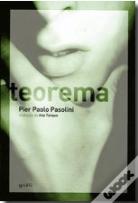
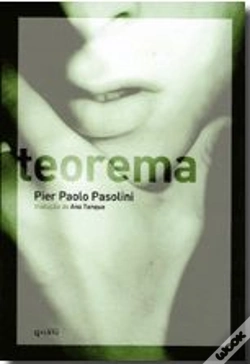
Pela primeira vez disponível em português, permeado de excertos poéticos, Teorema faz a descrição impiedosa dos comportamentos e conflitos que ocorrem no seio de uma família burguesa num momento de crise, e representa, ao mesmo tempo, uma parábola sobre a irrupção do religioso na ordem familiar e as suas consequências imediatas.
Provocador e profético, esta obra assinala uma viragem no percurso literário de Pasolini, que atinge uma visão sagrada e viva da realidade.
PRESS REVIEWS
Mónica Maia, Janeiro de 2006
DETAILS
| Property | Description |
|---|---|
| ISBN: | 9789895521050 |
| Publisher: | Quasi Edições |
| Release Date: | December of 2005 |
| Language: | Portuguese |
| Dimensions: | 160 x 236 x 27 mm |
| Cover: | Softcover |
| Pages: | 180 |
| Format: | Book |
| Collection: | Metamorfose |
| Categories: |
Books in Portuguese
>
Fiction
>
Poetry
|
| EAN: | 9789895521050 |
| Recommended Minimum Age: | Not applicable |
REVIEWS
Um espectáculo "Pasoliniano"
Maria Tomás Paula Marques Pinheiro Torres
Um "espectáculo" próprio de Pasolini que envolve o leitor numa família burguesa com um especial convidado que extrai os seus estereótipos sociais que residem nesta família e que os faz encararem a sua própria natureza. Um livro dinâmico na sua estrutura e com uma linguagem magnífica própria deste autor tão idiossincrático.
ABOUT THE AUTHOR
Pier Paolo Pasolini
Pier Paolo Pasolini was born on March 5, 1922, in Bologna. The son of a military man, he followed his father in his various moves, but attended high school and university in Bologna, where he was a student of Gianfranco Contini and Roberto Longhi. He spent his summers in Casarsa, in the Friuli region, his mother's hometown. He took refuge there in 1943 to escape conscription into the army. He composed his first poems in the Friulian dialect. Poesie a Casarsa (1942), published later, along with other Friulian texts, in La Meglio Gioventù (1958). In 1945, he learned that his younger brother, Guido, had been killed by Tito's followers in a conflict between two groups of partisansIn 1947, he joined the Communist Party. He worked as a teacher in a village near Casarsa, but was dismissed and expelled from the PCI for an obscure episode of alleged corruption of minors. This was the first of a huge list of trials (more than 30) that gave Pasolini an awareness of his diversity and marked his destiny as a marginalized and rebellious figure.
Because of the scandal, in 1949 he had to leave Casarsa to live with his mother (his relationship with his father was already strained) and moved to Rome, initially living in the suburbs and earning a living through private tutoring and teaching in private schools. His discovery of the world of the Roman sub-proletariat inspired him – in addition to poems in... Gramsci's Ashes (1957) and The Religion of My Time (1961) (written after The Nightingale of the Catholic Church (1943 - 1949, that is, before Gramsci's Ashes) - especially novels Vagrants (1955) and A Violent Life (1959), which caused a great scandal, but secured him his first literary success. With his former college colleagues Francesco Leonetti and Roberto Roversi, he directed the magazine between 1955 and 1959. Office, where Franco Fortini and Paolo Volponi, among other important figures in critical activism, collaborated.
However, he began his career in the film industry: he collaborated on several screenplays (among which...). Nights of Cabiria by Federico Fellini and La Notte Brava or The Handsome Antonio of Bolognini), and from 1961 onwards, he made several films, among which Accattone (1961), Mamma Roma (1962), La Ricotta (1962), Comizi d'Amore (1964), The Gospel According to Matthew (1964),Little Birds and Big Birds (1966), Oedipus RexI (1967), Theorem (1968), Medea (1969), Pigsty (1969) Decameron (1971), The Canterbury Tales (1972) The 1001 Nights (1974) and Salò, or the 120 Days of Sodom (1975).
Published in the 1960s. Il Sogno di Una Cosa (written in 1949), more poems (Poesia in Forma di Rosa, 1964, Transhumanize and Organize, 1971), and was very active as a critic in various newspapers and magazines (among others, he co-directed Nuovi Argomenti with Alberto Moravia and Alberto Carocci), an activity that, after the collection Passion and Ideology, was at the origin of many publications, some of them posthumous: Heretical Empiricism (1972), Corsair Writings (1975), Descriptions of Descriptions (1979).
In addition to several unfinished plays he wrote in his youth and translations of classics (Aeschylus, Plautus), his theatrical output consists of six tragedies, five of which were written in 1966: Calderón, Fabulation, Pylades, Pigsty, Orgy and Style Beast which he began writing in 1966 and continued until 1973, but it remained unfinished.
Pier Paolo Pasolini was murdered in Ostia in 1975.
BOOKS FROM THE SAME COLLECTION
-
O Beijo da Chama10%Quasi Edições6,00€ 10% CARD
-
A MetamorfoseQuasi Edições10,60€
BY THE AUTHOR
-
Entrevistas Corsárias10%VS. Editor18,00€ 10% CARDfree shipping
-
O Odor da Índia10%Desassossego16,60€ 10% CARDfree shipping