





adicionar à lista de desejos
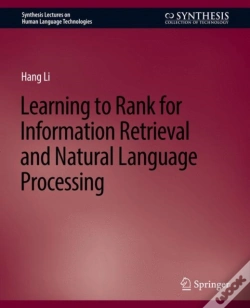
Learning To Rank For Information Retrieval And Natural Language Processing eBook
language: english
Publisher:
Springer International Publishing, November of 2022 ‧
see product details
105,99€
10% OFF
CARD
VFVvNFl6VXZkVEZRY2pZeFJVZEJTSEpFVDFOaGNrSmhOVEpRWmtoVFRta3hhRVl2ZVZadFRVTlhZVFI2V0VoMVprbElkRzVzYVZWT0sySkhWV3BWVDFScGRHbFdPRk13U0haTVJXRlpkbkZ4VEN0a1UycHRTbmRxTTFGdFVWRllZV1pwUW5KQ2F5dDFkR2szTkZnMGVYWTNMM3BSZERORVZYRnpiWFphYkM5SGRqQkNMM0p6VlhreEwzQmxNVFUyTlVKaE0yWmhWazlQT1ROT1NqVkdkWEptV0ZWTE1EWXJWa2hRTkRaeVpYcHdRWGswUzFOdFdXNXJNbUZ2VERsWFoySlNUbEpzTUdjek5XOTVPRkpoWm1OcmFUWllWMGt6ZFRnelpVZDZSMjB2VURKdFVWUk9MekZ5THpCc1RFRm5iMDFxYUd4SVNqWXplbEppTXpaMldVcEpMMVJRU1RaTWVGRkRhbUZ2UVVaelVuRkpOVFYzTkZCdWQzcGpTM2xyZEVGQlVWWk5PRFZZWldRNVJqVlllVkpPTkdrMmExZDJiRUZxZWtaWWFVRkJNa1I1WWxoaFNGaEphblkzZG5Kb1NWUlFLMWh1V0U1UFNsTlRRazFPWlcxeWNEZEpPRWdyUTNaVlMwRTRSamd6TlZCeFR6aDBTR1JLTjFOVk5rdHJVRlpPVTI5QmJDOXVTMUpxVXpWQ1ZtMVVSRFE0UXpsclNtOWhVM1JxSzFKWUx6QnJWa1EyVXpGc2RWaDVNRGRTTlU1TFVVZGlhSHB2Y25JMWQzaERPVE0xTVZGcGQyeExVMmw0ZGtnM1JFOURRa2wzZVhwcWFrUkZRVUowVTFWM1RIQTBZVWxCVEZscFpFZzBlR05STlVZd09YRmFNRFI1WjBKYWIwVXZRMVJ0V25Ca2NVdHVTRXgwVFZsQ1FtaHVVblp3YUV0c1QwNHlNbUV6TjFBMlZVMDJTbFprWm1OdVRXUkxSSEY0VkcxRE1XeHNPVUoxYW05bE9YZzJaVzV3VGtsNVZHdDNUekphYW0xRVZGaGtjMjlQYjNoR05raGFSMU5ZVVdremNXazVSRlJtVWxJeVdHVXpMMjh3Y1ZaTFIwVTJMMU55YWtSNFVGaEZSakJXVW10clZYVlFlbEl5V0NzeVQwbzJWME5TYlVsQmVta3pTMHc1VHpaNVF6QmhURFl4TlVoNGVIRk9ZbXRUVlVoNWFVMUtPRU0zWVRKVVluWkxSbXRoZWtwTFZqQTRPSFVyWnpWS1dYRTBOR0ZyUlhsNFR6aDBkRTFtYkVsalJFaDZZekowZEVWQmRHbFljVlJGUFE9PTpiaVdzUlp2VGNXVVpPNkczdS8wbjJBPT0=
IMMEDIATE AVAILABILITY
Ebook for ADE
SYNOPSIS
Learning to rank refers to machine learning techniques for training the model in a ranking task. Learning to rank is useful for many applications in information retrieval, natural language processing, and data mining. Intensive studies have been conducted on the problem recently and significant progress has been made. This lecture gives an introduction to the area including the fundamental problems, existing approaches, theories, applications, and future work. The author begins by showing that various ranking problems in information retrieval and natural language processing can be formalized as two basic ranking tasks, namely ranking creation (or simply ranking) and ranking aggregation. In ranking creation, given a request, one wants to generate a ranking list of offerings based on the features derived from the request and the offerings. In ranking aggregation, given a request, as well as a number of ranking lists of offerings, one wants to generate a new ranking list of the offerings.Ranking creation (or ranking) is the major problem in learning to rank. It is usually formalized as a supervised learning task. The author gives detailed explanations on learning for ranking creation and ranking aggregation, including training and testing, evaluation, feature creation, and major approaches. Many methods have been proposed for ranking creation. The methods can be categorized as the pointwise, pairwise, and listwise approaches according to the loss functions they employ. They can also be categorized according to the techniques they employ, such as the SVM based, Boosting SVM, Neural Network based approaches. The author also introduces some popular learning to rank methods in details. These include PRank, OC SVM, Ranking SVM, IR SVM, GBRank, RankNet, LambdaRank, ListNet & ListMLE, AdaRank, SVM MAP, SoftRank, Borda Count, Markov Chain, and CRanking. The author explains several example applications of learning to rank including web search, collaborative filtering, definition search, keyphrase extraction, query dependent summarization, and re-ranking in machine translation. A formulation of learning for ranking creation is given in the statistical learning framework. Ongoing and future research directions for learning to rank are also discussed. Table of Contents: Introduction / Learning for Ranking Creation / Learning for Ranking Aggregation / Methods of Learning to Rank / Applications of Learning to Rank / Theory of Learning to Rank / Ongoing and Future Work
DETAILS
| Property | Description |
|---|---|
| ISBN: | 9783031021411 |
| Publisher: | Springer International Publishing |
| Release Date: | November of 2022 |
| Language: | English |
| Format: | eBook |
| File Format and Compatibility: | PDF para ADE |
| Collection: | Synthesis Lectures On Human Language Technologies |
| Categories: |
eBooks in English
>
Computing
>
Other Applications
eBooks in English > Fiction > Linguistics and Philology |
| EAN: | 9783031021411 |
BOOKS FROM THE SAME COLLECTION
-
Online Hate Speech10%Springer International Publishing AG42,57€
47,30€free shipping -
Multilingual Entity Linking10%Springer International Publishing AG42,57€
47,30€free shipping
-
Machine Learning Methods10%SPRINGER VERLAG, SINGAPORE109,49€
121,66€free shipping -
Learning To Rank For Information Retrieval And Natural Language Processing, Second Edition10%Springer International Publishing AG37,84€ 10% CARDfree shipping