

adicionar à lista de desejos
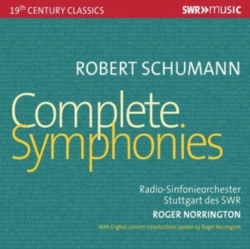
Robert Schumann: Complete Symphonies - CD Music
label:
SWR Music, January of 2022 ‧
see product details
OUT OF STOCK OR NOT AVAILABLE
ARTICLE DESCRIPTION
ALIGNMENT
Disco 1
01 - I. Andante Un Poco Maestoso - Allegro Molto Vivace
02 - II. Larghetto
03 - III. Scherzo. Molto Vivace
04 - IV. Allegro Animato E Grazioso
05 - I. Lebhaft
06 - II. Scherzo. Sehr Mäßig
07 - III. Nicht Schnell
08 - IV. Feierlich
09 - V. Lebhaft
10 - Symphony No. 1 in B-flat Major
11 - Symphony No. 3 in E-flat Major
Disco 2
01 - I. Sostenuto Assai - Allegro, Ma Non Troppo
02 - II. Scherzo. Allegro Vivace
03 - III. Adagio Espressivo
04 - IV. Allegro Molto Vivace
05 - I. Andante Con Moto - Allegro Di Molto
06 - II. Romanza. Andante
07 - III. Scherzo. Presto - Largo
08 - IV. Finale. Allegro Vivace - Stringendo - Presto
09 - Symphony No. 2 in C Major
10 - Symphony No. 4 in D Minor
ABOUT THE ARTIST
Robert Schumann
Robert Schumann was one of the most important composers and music critics of the nineteenth century, born on June 8, 1810 in Zwickau, Germany, and died on July 29, 1856 in Endenich, near Bonn, Germany. Schumann is widely recognized as one of the central figures of musical romanticism, and his work is known for its deep emotional expressiveness, rich melodic inventiveness, and its exploration of music as an extension of literature.
Schumann began his career with ambitions to become a virtuoso pianist, but a hand injury forced him to abandon that idea and concentrate on composition. He studied music in Leipzig, where he was a student of Friedrich Wieck, whose talent and guidance helped him develop his skills. Schumann later married Clara Wieck, Friedrich's daughter, who was an exceptional pianist and also an important inspiration for his music.
Schumann was a prolific composer, writing works in various genres, including chamber music, symphonies, concertos, and a vast amount of songs (lieder). The year 1840, known as Schumann's "year of songs", was particularly productive, during which he composed more than 150 lieders. Among his most famous song cycles are Dichterliebe (1840) and Frauenliebe und-leben (1840), which are landmarks of the vocal repertoire, known for the way Schumann combines music with poetry.
In the field of orchestral music, Schumann is remembered for his four symphonies, especially Symphony No. 1 (Spring) and Symphony No. 3 (Rhineland), which demonstrate his ability to combine classical form with a romantic spirit. He also wrote important works for piano, such as the Carnival (1835), Kinderszenen (1838), Kreisleriana (1838), and Fantasia in C Major (1836), which are some of the most representative pieces of musical Romanticism.
In addition to his career as a composer, Schumann was an influential music critic, founding the Neue Zeitschrift für Musik magazine in 1834. Through this publication, he promoted and championed the work of emerging composers such as Johannes Brahms, who would become one of his closest friends.
The last years of Schumann's life were marked by serious mental health problems, which led to his being committed to an asylum in 1854, where he spent the last two years of his life. Despite his personal challenges, Robert Schumann's legacy continues to be celebrated, and his music is considered a deep expression of the romantic soul, combining passionate lyricism with a rich palette of harmonic colors and musical textures.
BY THE SAME ARTIST
-
Symphony No. 1 "Spring" / Symphony No. 2 - CD10%Sony Classical27,36€ 10% CARDfree shipping
-
imagem não disponívelSchumann: Novelletten Op. 21/Nachtstücke Op. 23 - CDSchumann: Novelletten Op. 21/Nachtstücke Op. 23 - CD10%Piano Classics28,94€ 10% CARDfree shipping