


adicionar à lista de desejos
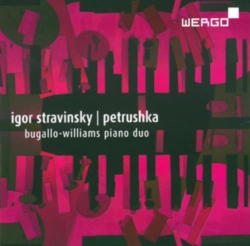
Igor Stravinsky: Petrushka - CD Music
label:
Wergo, June of 2018 ‧
see product details
OUT OF STOCK OR NOT AVAILABLE
ARTICLE DESCRIPTION
ALIGNMENT
Disco 1
01 - The Shrovetide Fair
02 - The Magic Trick
03 - Russian Dance
04 - Petrushka's Room
05 - The Moor's Room
06 - Dance of the Ballerina
07 - Waltz/Appearance of Petrushka
08 - The Shrovetide Fair (Toward Evening)
09 - Dance of the Nursemaids
10 - The Peasant and the Bear
11 - The Jovial Merchant With Two Gypsy Girls
12 - Dance of the Coachmen and Grooms
13 - The Mummers
14 - Concertino for Piano Four Hands
15 - Pas-de-quatre
16 - Double Pas-de-quatre
17 - Triple Pas-de-quatre
18 - Prelude
19 - First Pas-de-trios
20 - Gailliarde
21 - Coda
22 - Interlude
23 - Second Pas-de-trios
24 - Bransle Gay
25 - Bransle Double
26 - Interlude
27 - Pas-de-deux
28 - Coda
29 - Four Duos
30 - Four Trios
31 - Coda
32 - Scherzo À La Russe
DETAILS
| Property | Description |
|---|---|
| label: | Wergo |
| Release Date: | June of 2018 |
| Dimensions: | 125 x 140 x 8 mm |
| Format: | Music |
| Categories: |
Classic
>
Camera Music
|
| EAN: | 4010228737127 |
| Number of disks: | 1 |
| Format: | CD / Album |
ABOUT THE ARTIST
Igor Stravinsky
Igor Stravinsky was one of the most influential composers of the twentieth century, born on June 17, 1882 in Oranienbaum (now Lomonosov), Russia, and died on April 6, 1971 in New York, United States. Stravinsky is widely recognized for his innovation and ability to transform the classical music landscape through his works, which often challenged the musical conventions of his time.
Stravinsky gained international notoriety with his collaboration with the Ballets Russes, a ballet company directed by Sergei Diaghilev. It was for this company that he composed three of his most famous works: The Firebird (1910), Petrushka (1911) and The Rite of Spring (1913). The Rite of Spring, in particular, caused great controversy at its premiere in Paris due to its dissonant and complex rhythmic music, as well as Vaslav Nijinsky's innovative choreography. This work is often cited as a milestone in the history of music and a turning point in modern music.
Throughout his career, Stravinsky demonstrated an incredible capacity for adaptation and reinvention. He went through several distinct stylistic phases, including the use of neoclassical styles in the 1920s and 1930s, where he drew inspiration from the music of the past, especially from the Baroque and Classical periods. Works such as the Symphony of Psalms (1930) and Pulcinella (1920) exemplify this neoclassical period.
In the last phase of his life, Stravinsky embraced serialism, a technique associated with composers such as Arnold Schoenberg, which involves the use of twelve-tone series. His work Agon (1957) is an example of this phase, showing his ability to assimilate new compositional techniques.
In addition to being a prolific composer, Stravinsky was also a respected conductor and author of several writings on music. He left an indelible mark on twentieth-century music, not only through his compositions, but also through his influence on other composers and musicians. His ability to constantly innovate while maintaining an emotional and intellectual depth in his music has earned him a place as one of the most important figures in the history of classical music.
BY THE SAME ARTIST
-
Stravinsky: Oedipus Rex/Apollon Musagète - CD10%LSO Live3,90€ 10% CARD
-
The Firebird (Ballet) • The Sorcerer's Apprentice - CD10%IMP Classics13,44€ 10% CARD