




adicionar à lista de desejos
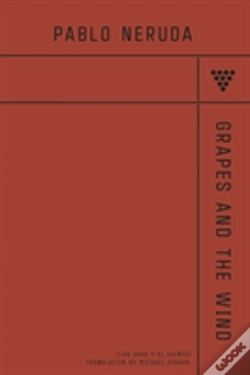
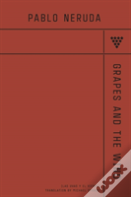
Grapes And The Wind
language: english
Publisher:
Spuyten Duyvil, May of 2018 ‧
see product details
OUT OF STOCK OR NOT AVAILABLE
Sell your book
SYNOPSIS
Michael Straus' translations of these poems bring to light Neruda's identity as an ego obscured in the surrealism of plants, places, and people. Straus has found English that synchs with Neruda's desire. Vincent Katz
DETAILS
| Property | Description |
|---|---|
| ISBN: | 9781944682989 |
| Publisher: | Spuyten Duyvil |
| Release Date: | May of 2018 |
| Language: | English |
| Dimensions: | 152 x 229 x 20 mm |
| Cover: | Softcover |
| Pages: | 376 |
| Format: | Book |
| Collection: | Sweet Sanctuary Series |
| Categories: |
Books in English
>
Fiction
>
Poetry
|
| EAN: | 9781944682989 |
ABOUT THE AUTHOR
Pablo Neruda
NOBEL PRIZE FOR LITERATURE 1971
Literary name of the Chilean poet, diplomat and Marxist Neftalí Ricardo Reyes Basoalto. He was born on July 12, 1904 in Parral, Chile, and died on September 23, 1973, in Santiago. From a humble family, he lived in the south of Chile, in Temuco. His mother died a few months after his birth and his father would remarry. Neruda would have a good relationship with his stepmother, whom he considered his real mother. He once wrote "I was born for life, for the earth, for poetry and for rain". He studied at the high school of this city, entering the Pedagogical Institute of the University of Santiago at the age of 15. He started writing at the age of 10. When he was only 12 years old, he met Gabriela Mistral, a famous Chilean poet, who introduced him to the classic writers who would influence his career and political decisions. He became an anarchist militant and translated the work of Jean Grave, the remarkable theory of Peter Kropotkin, a communist anarchist. From 1920 onwards he began to use the name Pablo Neruda, which he legally adopted in 1946. In 1921 he left Temuco and moved to the capital, Santiago. The romantic student invaded the literary life of the Chilean capital with his student cape. That year he won the prize of the Chilean federation of poetry students with La canción de la fiesta and from then on he began to publish poems in the federation's magazine, Claridad. In 1923 he wrote his first book, Crepusculario. To cover the expenses of this publication, he was forced to sell the watch that his father had given him. In 1924 he found someone to publish Viente poemas de amor y una canción desesperada. This work was very well received by the public and has retained its popularity over the years. At the age of twenty and with two books published, Neruda became the best-known Chilean poet. He abandoned his studies in French to devote himself entirely to poetry. He wrote Tentative of infinite hombre, Anillos , in collaboration with Tomás Lago, and El hondero enthusiast.
In 1927 he was appointed consul in Rangoon, Burma, and for five years he represented his country in Asia. He then traveled to Ceylon, Colombo, Jakarta, Java, where he married his first wife, of Dutch origin. He was also in Singapore. He lived through a period of great loneliness, animated only by his romance with a young Burmese woman. During these years in Asia he wrote Residencia en la tierra. In 1933 he was appointed consul in Buenos Aires and from there dates his friendship with the Spanish poet Federico García Lorca. The following year he was transferred to Barcelona and then to Madrid where he remarried, this time to Delia del Carril.
With the same literary impact that he obtained in his country, Neruda conquered Europe and the rest of the world, his poetry quickly became known. He was a writer well received in Spain. This climate of poetic development was suddenly interrupted by the outbreak of the Spanish Civil War in 1936. The execution of his friend García Lorca, the imprisonment of Miguel Hernández and the blood in the streets contributed to the maturity of the poet and his political attitudes. He then wrote España en el corazón, published during the civil war on the Republican front lines.
Pablo Neruda returned to Chile in 1938, with a group of Spanish refugees. After this attitude, the Chilean government sent him to Mexico where he produced intense poetic texts, inspired by the Second World War, which was ravaging Europe, positioning himself especially on the side of the defense of Stalingrad against the German occupation.
In 1943 he returned to Chile by sea, receiving a great ovation from his countrymen. In 1945 he was elected senator and for the next three years he devoted most of his time to the country's problems. Neruda's political activity was interrupted when a right-wing government was elected. Pablo Neruda, a communist, was forced to hide his ideology, as were other leftists. These years of clandestinity were, however, fruitful from the point of view of literary work. He wrote Canto General, one of the great epic poems written on the American continent. In February 1948, he left Chile, crossing the southern part of the Andes mountains on horseback. In June 1949 he visited the Soviet Union to participate in the celebration of the 150th birthday of Alexander Pushkin. He then visited other European countries and Mexico. In 1952, after the order for the arrest of leftist writers and political figures was withdrawn, Neruda returned to Chile and married for the third time, to Chilean Matilde Urrutia. With his residence on the Black Island, in the Pacific, he traveled constantly to several countries, including Cuba and the United States, respectively in 1960 and 1966. His poetry has been translated into almost all languages.
Neruda's poetry represents a constant change, related to the experiences of his life. One of the most enigmatic works is Residencia en la tierra where he broke with the traditional form and created a highly personalized poetic technique yet full of realism, which became known as "nerudism".
Pablo Neruda was awarded the National Prize for Literature, the Lenin Peace Prize (1953) and the Nobel Prize for Literature (1971).
Pablo Neruda. In Infopédia. Porto: Porto Editora, 2003-2011.
BOOKS FROM THE SAME COLLECTION
-
Black SenateWahida Clark Presents Publishing, LLC25,02€
-
Arkansas Total Eclipse GuideSastrugi Press13,45€
BY THE AUTHOR
-
Poemas de Amor10%Dom Quixote13,90€ 10% CARD
-
Antologia10%Relógio D'Água25,24€ 10% CARDfree shipping